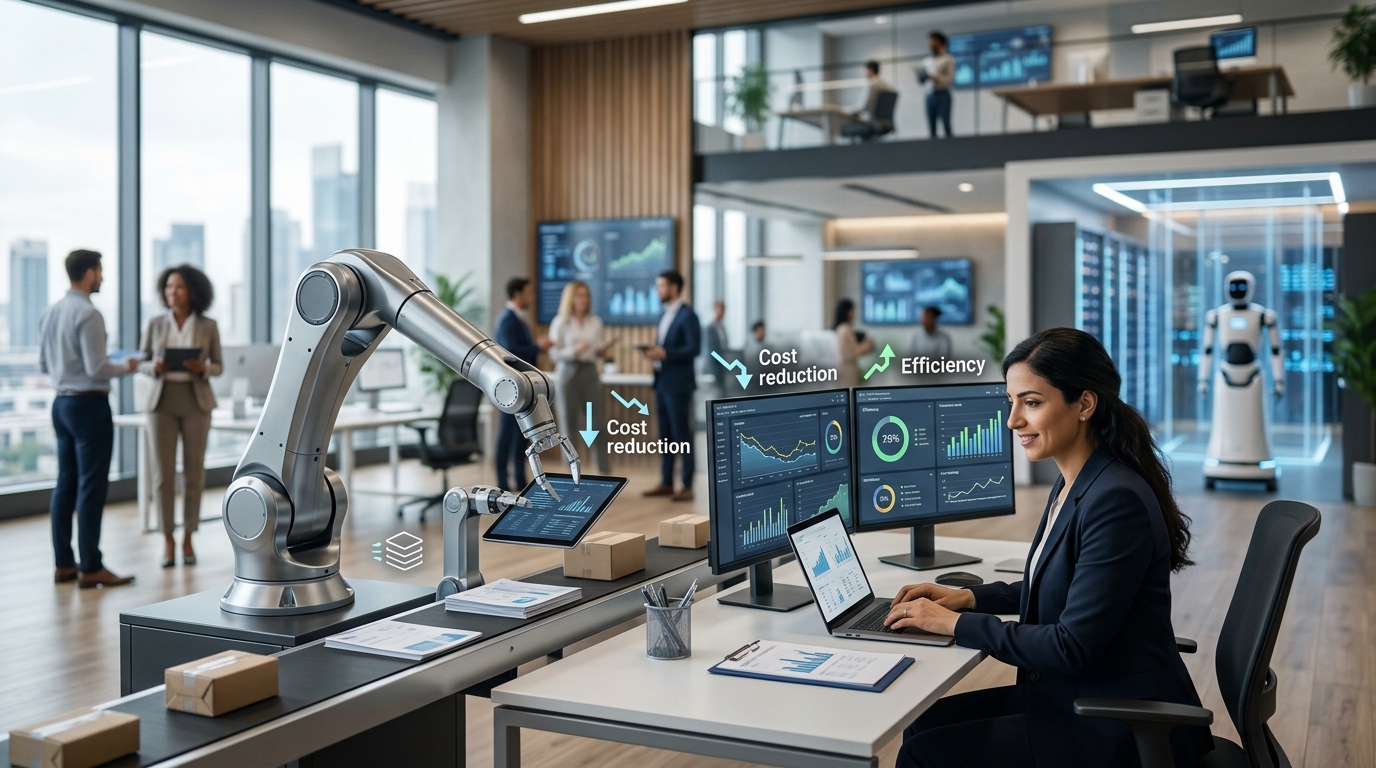
The Automation Revolution: How it Reduces Companies' Operational Costs
A Strong Introduction
Amidst the rapid economic transformations and intense competition witnessed in today's global market, companies are constantly seeking innovative strategies to enhance their efficiency and achieve maximum profitability. Reliance on traditional methods is no longer sufficient to stay ahead; rapid adaptation to technological changes has become imperative. In this context, automation has emerged as a key driving force, capable of reshaping companies' operational landscape by radically improving processes and reducing waste.
Automation, in its various forms and applications, is a cornerstone in building more flexible and sustainable business models, extending beyond mere simplification of routine tasks to include complex data analysis and strategic decision-making. Its direct impact on reducing operational costs is a primary driver for its adoption, enabling companies to free up their financial and human resources for investment in growth and innovation. This article delves into how automation tools contribute to achieving this vital goal, exploring the different dimensions of this technological revolution and its economic implications.
Background and Context
The idea of automation was not born in the modern era; its roots extend to the First Industrial Revolution, where machines began to replace manual labor in factories to increase productivity. This idea evolved over decades, through the Second Industrial Revolution which brought automated production lines, and the Third which focused on the use of electronics and information technology in manufacturing and administrative processes. Each stage primarily aimed at improving efficiency and reducing reliance on human intervention in repetitive tasks, which naturally led to cost reduction.
In the new millennium, automation witnessed a qualitative leap thanks to tremendous advancements in artificial intelligence, machine learning, and Robotic Process Automation (RPA), which enabled the automation of not only physical tasks but also complex cognitive and administrative tasks. This development came in response to several driving factors, most notably the increasing pressure on companies to achieve maximum operational efficiency in a global market characterized by volatility and intense competitive pressures. The desire to improve the quality of services and products and reduce human errors also contributed to accelerating the adoption of automation solutions more broadly.
Today's business world faces unprecedented challenges related to rising operating costs, whether labor costs, administrative costs, or costs associated with errors and rework. These challenges push companies to seek radical solutions, not just marginal improvements, and here automation emerges as an integrated strategic solution. It not only provides a means to reduce direct costs but also allows companies to redirect their resources towards innovation and development, giving them a sustainable competitive advantage in a constantly evolving market. Understanding the context of this technological revolution has become essential for every organization aspiring to grow in the era of digital transformation.
The widespread adoption of the internet, the availability of big data, and the development of cloud infrastructure are all factors that have converged to accelerate the pace of automation adoption. Automation is no longer exclusive to large corporations with massive budgets; it has become increasingly accessible to small and medium-sized enterprises thanks to the emergence of more flexible and affordable solutions. This democratic expansion in access to automation tools confirms that it is not just a fleeting trend, but an integral part of modern business strategy, and a fundamental pillar for reducing financial burdens and improving the overall performance of organizations of all sizes and sectors.
Details and Key Facts
The facets of automation's impact on reducing operational costs are numerous, encompassing multiple vital areas within any organization. Prominent among these areas is the reduction in the need for human intervention in routine and repetitive tasks, which directly leads to lower labor costs. For instance, automation tools can process supplier invoices, manage employee requests, or even respond to frequent customer inquiries with high efficiency around the clock, without the need to employ a large number of staff to perform these tasks manually.
In addition to saving labor costs, automation plays a crucial role in reducing human errors that often cost companies substantial amounts. Errors in data entry, accounting processes, or inventory management can lead to significant financial losses, in addition to wasting time and effort in correcting them. Automated systems, once correctly programmed, execute tasks with extreme precision, significantly reducing the error rate and improving output quality, thereby limiting costs associated with rework or compensation.
Automation also contributes to improving the efficiency of resource and time utilization, two essential factors in determining operational costs. For example, in the manufacturing sector, industrial robots can operate continuously without interruption, increasing production speed and reducing downtime, thereby boosting operational efficiency and lowering the cost per unit produced. In offices, workflow automation can streamline administrative processes, such as document approvals or task distribution, saving valuable working hours that can be utilized for higher value-added activities.
Numerous specialized studies and reports show that companies adopting automation experience a significant reduction in their operational costs, ranging between 15% and 30% within a few years of implementation. For instance, industry experts estimate that automating administrative tasks alone can save medium-sized companies up to thousands of hours annually, translating into substantial financial savings. Furthermore, the use of artificial intelligence in predictive data analysis helps companies improve inventory management, production planning, and even forecast future demand with greater accuracy, which reduces storage and waste costs and generally improves cash flow.
Impact and Importance
The impact of automation on reducing operational costs is not limited to direct financial savings alone, but extends to enhancing companies' competitiveness at both local and global levels. When companies can produce goods or provide services at a lower cost, they become able to offer more attractive prices to consumers, increase their profit margins, or invest in research and development, all of which strengthen their market position. This overall economic impact contributes to driving economic growth by improving general productivity.
At the local level, adopting automation can lead to a shift in the nature of jobs, as labor is transitioned from routine tasks to tasks requiring higher skills in analysis, planning, and creativity. This transformation encourages investment in human capital development and upskilling, benefiting the national economy as a whole. Furthermore, local companies that adopt automation become more efficient, enabling them to compete more effectively with global companies that may have greater resources.
Globally, companies that leverage automation can expand into new markets and offer innovative products and services at a low cost, which enhances international trade and contributes to more flexible and efficient supply chains. Automation allows multinational corporations to standardize their operations across geographical borders, reducing operational discrepancies and providing significant economies of scale. This contributes to creating a more interconnected and efficient global business environment, where companies can respond more quickly to market demands and challenges.
Moreover, automation represents a crucial tool for companies in challenging times, such as economic or health crises. The COVID-19 pandemic demonstrated how companies with higher levels of automation in their operations were better able to adapt to supply chain disruptions and changes in work patterns, allowing them to maintain business continuity and minimize losses. This strategic impact reinforces the importance of automation as a long-term investment in business resilience and its ability to withstand future challenges, confirming that it is not merely a cost-reduction tool but a fundamental pillar for stability and growth.
Opinions and Analyses
Experts and analysts in the technology and business sectors agree that automation is no longer a luxury option, but has become a strategic necessity for companies seeking to stay ahead of the competition and achieve sustainable growth. Numerous reports from global research institutions, such as McKinsey and Gartner, indicate that companies adopting comprehensive automation strategies achieve significantly higher returns on investment compared to those hesitant to embrace these technologies. These returns are not limited to financial savings alone, but also include improved customer satisfaction, increased operational flexibility, and accelerated innovation.
However, the process of transitioning to automation is not without its challenges and considerations that companies must take into account. Among the most prominent of these challenges is the initial cost of investing in automation systems, which can be high at first. Effective implementation of automation requires careful planning, selection of appropriate tools, and training employees on how to interact with new systems. Some analysts believe that companies should view this investment as an opportunity to strengthen their technological infrastructure and achieve long-term gains, rather than focusing solely on immediate costs.
One important aspect that analysts focus on is the need to strike a balance between automation and the human element. While automation can replace routine tasks, it cannot substitute the need for creativity, critical thinking, emotional intelligence, and complex problem-solving skills that humans possess. Therefore, experts advise companies to adopt an approach that integrates automation as a tool to empower employees and free them to perform higher value-added tasks, rather than viewing it as a threat to jobs. This approach leads to the creation of new job opportunities in areas such as automation system management, data analysis, and innovative solution design.
Analysts also emphasize the importance of choosing appropriate automation solutions that align with the company's specific needs and objectives. There is no one-size-fits-all solution; what works for a large manufacturing company may not be suitable for a small service company. This requires a comprehensive assessment of current operations, identification of weaknesses, and areas where automation can achieve the greatest impact. In addition, companies must be prepared for continuous adaptation and change, as automation technologies evolve rapidly, necessitating regular updates to systems and skills to maintain efficiency and effectiveness.
Outlook and Future
Experts anticipate that automation will continue to evolve at an accelerated pace, encompassing broader and more complex areas in the business world. One of the most prominent future trends is the concept of "Hyperautomation," which involves a combination of various automation technologies such as Robotic Process Automation, Artificial Intelligence, Machine Learning, and Natural Language Processing, to create comprehensive and intelligent automation solutions. Hyperautomation aims to automate as many business and technical processes as possible, minimizing the need for human intervention and increasing operational efficiency to an unprecedented degree.
The future also points to an increasing reliance on AI-powered automation in decision-making. With the ability to analyze vast amounts of data in real-time, automated systems will be able to provide valuable insights and accurate recommendations, and even make executive decisions in areas such as risk management, demand forecasting, and supply chain optimization. This development will bring about a qualitative shift in companies' ability to respond to market changes and plan for the future more effectively, thereby enhancing their capacity to reduce indirect costs associated with incorrect or delayed decisions.
On another front, the automation industry is expected to see significant growth in Low-code/No-code automation solutions, which will enable non-programmers to build automated applications and workflows more easily. This trend will democratize access to automation tools and expand the user base, allowing small and medium-sized enterprises to adopt customized automation solutions for their needs at lower cost and in less time. This means that automation will not be exclusive to large corporations with extensive technical resources, but will become an essential tool accessible to everyone.
As for the future of employment, the nature of jobs is expected to change radically, with new professions emerging that focus on designing, maintaining, and analyzing the outputs of automation systems. Employees will need to develop new skills, such as data analysis, basic programming, and design thinking, to remain relevant in the job market. This transformation will create opportunities for professional growth and contribute to building a workforce that is more flexible and adaptable to the demands of the digital age, confirming that the future is not about replacing humans with machines, but about empowering humans with AI and automation to achieve unprecedented levels of accomplishment.
Conclusion
In conclusion, there is no denying that automation tools have brought about a true revolution in the way companies operate, offering radical solutions for reducing operational costs and enhancing overall efficiency. Automation has proven its ability to transform routine and time-consuming tasks into fast and accurate processes, freeing up human and financial resources to focus on innovation and expansion. Companies that recognize this transformative power and adopt it with strategic awareness are those that will achieve a sustainable competitive advantage in a dynamic and constantly challenging market.
Investing in automation is not merely a tactical decision to cut expenses, but a long-term strategy aimed at building a more agile, efficient, and adaptable organization capable of responding to future changes. It represents an investment in the company's future, enabling it to maximize its resources, minimize errors, and improve the quality of services and products offered. This approach not only ensures financial sustainability but also enhances the company's reputation and market position.
Therefore, we call upon all leaders and decision-makers in companies, regardless of their size or sector, to re-evaluate their operational strategies and seriously consider integrating automation solutions into the core of their businesses. Hesitation in adopting these technologies may lead to a loss of competitiveness and falling behind in a rapidly evolving world. Digital transformation and automation must be at the forefront of priorities, not only to reduce costs but to open new horizons for growth and innovation and create real value for customers and stakeholders alike. The future belongs to the automated, and to organizations that embrace change with courage and wisdom.
Related Articles

How Geopolitical Tensions and Advanced Technology Reshape the Global Economy
A comprehensive analysis of the impact of geopolitical conflicts, the artificial intelligence revolution, and the debt crisis on restructuring the global economy, changing power balances, and the movement of emerging and advanced markets.

The Future of the Global Economy in Light of Digital Transformation
The global economy is undergoing an unprecedented radical transformation driven by the digital revolution. From artificial intelligence to the Internet of Things and blockchain, these technologies are reshaping industries, creating new business models, and changing the nature of work. This article provides a comprehensive overview of the immense opportunities offered by this transformation, along with the significant challenges that must be addressed to ensure a more inclusive and sustainable economic future.

The Impact of Artificial Intelligence on the Labor Market and Jobs
The world is witnessing an unprecedented technological revolution led by artificial intelligence. This revolution is fundamentally reshaping the concepts of work and jobs. Explore with us how the global labor market is preparing for these fundamental transformations and what that means for the future of millions of workers and job seekers.