
How Geopolitical Tensions and Advanced Technology Reshape the Global Economy
Introduction: A Historic Crossroads and the End of Traditional Economic Cycles
The global economy today stands at an exceptional historic crossroads, where deep structural crises intertwine with rare investment opportunities, in a scene of extreme complexity not witnessed on the international stage since the late Cold War. The discussion in financial and economic decision-making circles is no longer merely tracking classical cycles oscillating between recession and recovery; it has gone far beyond that towards comprehending a comprehensive and radical restructuring process of the global financial, trade, and industrial system.
Today, multiple major forces intersect to reshape this landscape from its foundations: from the tight monetary policies adopted by major central banks, to the sharp divisions in global supply chains, all the way to the accelerating technological revolutions that are rewriting the rules of the economic game from scratch. This complex interaction is giving rise to an entirely new economic reality, demanding sophisticated analytical tools and strategies characterized by maximum flexibility and a real capacity for adaptation from decision-makers and investors.
First: The Era of Geo-economic Fragmentation and the Redrawing of Supply Chains
The curtain has officially fallen on the golden era of "hyper-globalization," an era characterized by an almost absolute freedom for the flow of goods, services, and capital across borders with minimal customs and regulatory restrictions. Today, geopolitics has regained its dominant and decisive role in guiding the trajectory of the global economy.
- End of the "Lowest Cost" Criterion: Escalating trade tensions between major economic powers and simmering conflicts in vital regions have led to a deep strategic shift among multinational corporations. "Lowest cost" is no longer the sole or primary criterion in selecting locations for industrial and production facilities.
- Economic Security First: New strategic concepts have emerged that now govern international trade trends, foremost among them "Friend-shoring," based on relocating manufacturing to politically allied countries, and "Near-shoring," aimed at reducing distances and enhancing logistical resilience.
- Winners and Losers: "Economic security" and "supply chain resilience" have become the obsession of every decision-maker. This profound transformation offers promising developmental and investment opportunities for emerging economies that possess a distinct geographical location and a balanced network of political relations. However, it simultaneously imposes long-term structural inflationary pressures on the end consumer worldwide, due to the inevitable increase in production and shipping costs.
Second: The Intractable Inflation Dilemma and Strict Monetary Policies
After more than a decade during which markets became accustomed to "cheap money," quantitative easing, and zero interest rates, the global economy suddenly awoke to a violent inflationary shock. This shock prompted major central banks—foremost among them the US Federal Reserve and the European Central Bank—to drain liquidity from markets and adopt tight monetary policies in the face of surging living costs.
- Complications of the "Last Mile": Despite positive indicators showing inflation rates slowing, economic experts agree that the "last mile" in curbing inflation and reaching official targets hovering around 2% is fraught with extreme complexity and risks.
- Repercussions of High Interest Rates: Keeping interest rates at elevated levels for prolonged periods ("Higher for Longer") automatically translates into onerous borrowing costs for companies, individuals, and governments alike. This pressure weighs on profit margins, curbs global economic growth momentum, and casts a shadow on financial stability, especially in credit-fragile sectors such as commercial real estate and highly leveraged startups.
Third: The Global Debt Time Bomb and the Emerging Markets Crisis
Global debt levels, both public and private, have surpassed unprecedented astronomical figures in modern economic history, exceeding global GDP multiple times over. With the persistence of high interest rates, "servicing this debt"—paying interest and installments—has transformed into a suffocating burden that drains public budgets and restricts countries' ability to invest in future projects.
- Emerging Markets in the Eye of the Storm: Emerging markets and developing countries top the list of the most fragile victims facing this aggravating structural crisis.
- Capital Flight: With the growing attractiveness of the US dollar as a safe haven, the pace of capital outflow from emerging markets towards developed economies accelerates in search of high and guaranteed returns.
- Specter of Financial Default: The inevitable consequence of this reality is the escalation of balance of payments crises and a rapid erosion of foreign reserves in developing countries. This situation narrows their room for maneuver in financing development and infrastructure projects and social welfare programs, and dramatically raises the probability of sovereign debt default.
Fourth: Artificial Intelligence... Super Growth Engine or Job Destroyer?
Amidst these accumulated challenges and heavy economic clouds, the "Generative AI" revolution emerges as a potential catalyst for an exceptional economic cycle of productivity and growth, which could radically redraw the global economic landscape.
- Trillion-Dollar Gains: Reliable economic estimates indicate that the widespread and rapid adoption of advanced AI technologies is capable of adding trillions of dollars to global economic output over the next decade. This will come through automating complex tasks, accelerating scientific and medical innovation, and enhancing operational efficiency across all sectors.
- Labor Market Disruptions: However, this rapid technological transformation is not without heavy costs; it carries deep and unprecedented disruptions in labor markets. Professions that for decades remained immune to automation fears—such as clerical, accounting, analytical, and creative tasks—are now at the heart of the scene and exposed to successive waves of technological replacement.
- Role of Governments: The biggest challenge for governments lies in building urgent proactive strategies to re-skill the workforce and develop their competencies, and to design robust social protection systems capable of absorbing this "technological shock" without widening the class divide or threatening the social fabric of societies.
Fifth: The Shift Towards a Green Economy and Global Energy Security Challenges
The path to clean energy and combating climate change has transcended the intellectual luxury of rich economies or resounding slogans at international conferences, transforming into a solid economic necessity that strongly imposes itself on the global investment agenda.
- Giant Investment Opportunities: The capital investments required to execute the transition to "net-zero emissions" are estimated at tens of trillions of dollars over the coming years. This historic transformation creates emerging economic sectors from scratch—such as the green hydrogen industry, large-scale energy storage battery technology, and electric vehicle supply chains—thereby attracting massive investment flows and creating millions of new jobs.
- The "Greenflation" Dilemma: However, the price of this rapid transition is not to be underestimated; it gives rise to sharp temporary price pressures known as "Greenflation," stemming from the rocket-like rise in prices of vital and rare metals that are an essential lifeline for clean industries, such as lithium, cobalt, and copper.
- Energy Security: Furthermore, the hasty abandonment of fossil fuels before reliable and affordable renewable alternatives are available poses a real threat to "global energy security," threatening market stability and exposing vital supplies to industrial sectors to unforeseen consequences.
Conclusion: A Roadmap Towards a New Global Economic Order
The global economy today is undergoing a difficult labor and a comprehensive readjustment of its fundamental equations and rules. In this era teeming with uncertainty and violent fluctuations, success and survival will not be the allies of those who cling to rigid economic and investment models that reality has proven outdated.
The winners in the next decade will be only those who possess the institutional flexibility to rapidly and steadily absorb sharp geopolitical shifts, the proactive ability to leverage modern technology as a driver for productivity and innovation, and the deep strategic vision to foresee sustainability and renewable energy sectors as a path to long-term value creation. Decision-makers, business leaders, and strategic investors are demanded today—more than at any point in history—to read the overall economic landscape (Macro-economic landscape) with depth and objectivity, and to completely liberate themselves from the narrow and short-sighted horizon, in favor of building dynamic strategies capable of absorbing shocks and seizing rare opportunities, in a world that never stops transforming and renewing.
Related Articles

The Future of the Global Economy in Light of Digital Transformation
The global economy is undergoing an unprecedented radical transformation driven by the digital revolution. From artificial intelligence to the Internet of Things and blockchain, these technologies are reshaping industries, creating new business models, and changing the nature of work. This article provides a comprehensive overview of the immense opportunities offered by this transformation, along with the significant challenges that must be addressed to ensure a more inclusive and sustainable economic future.
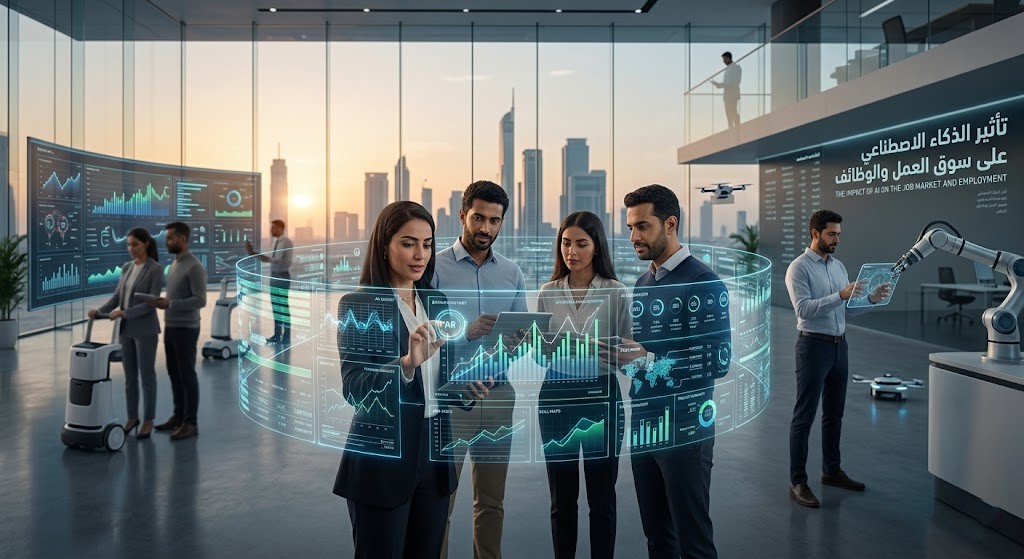
The Impact of Artificial Intelligence on the Labor Market and Jobs
The world is witnessing an unprecedented technological revolution led by artificial intelligence. This revolution is fundamentally reshaping the concepts of work and jobs. Explore with us how the global labor market is preparing for these fundamental transformations and what that means for the future of millions of workers and job seekers.

Secrets of Successful Investment in Global Stock Markets: A Smart Investor's Guide
Investing in global stock markets is a gateway to achieving wealth and growing capital, but it requires a deep understanding and well-thought-out strategies to overcome risks and seize opportune moments. This article unveils the fundamental principles and hidden secrets that enable investors to achieve rewarding returns in volatile international financial markets.