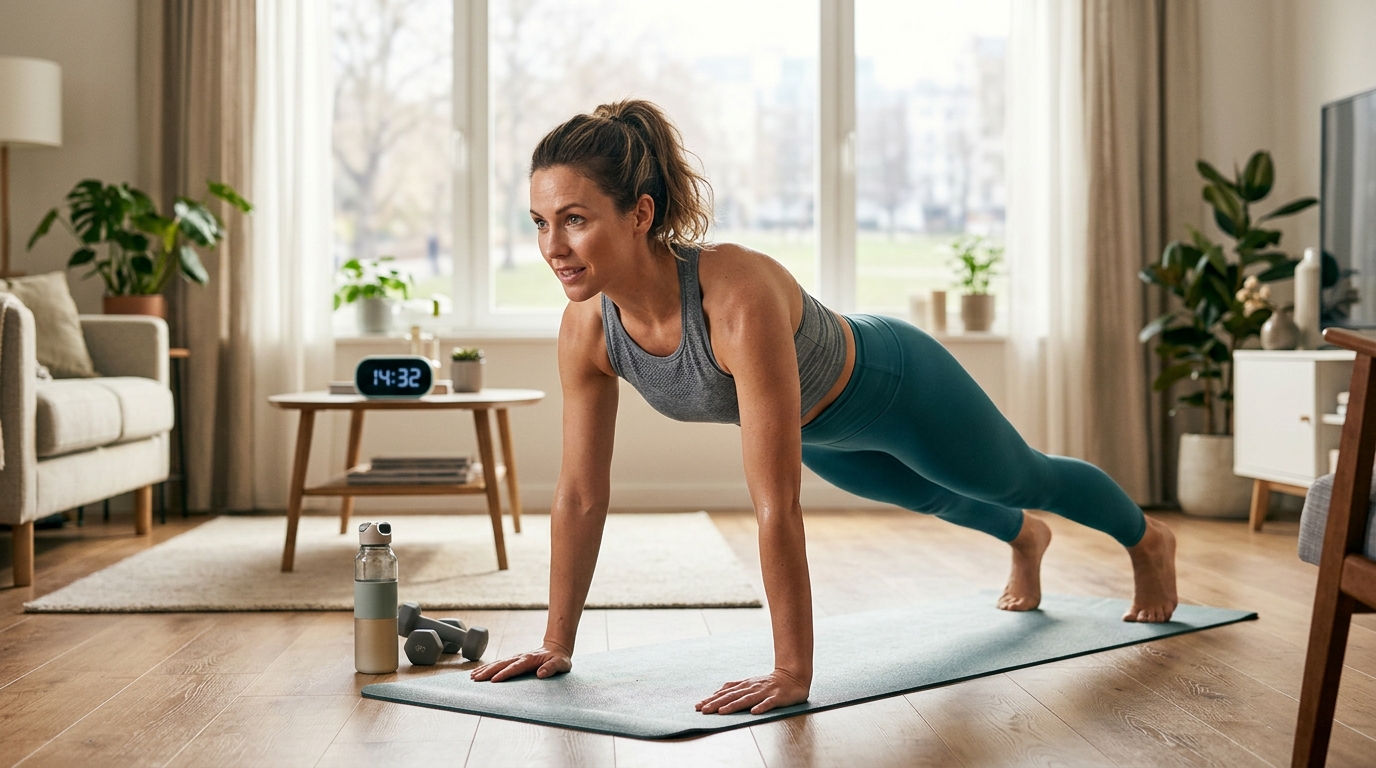
A 15-Minute Daily Home Routine to Stay Fit
Introduction
Amidst the growing challenges imposed by modern lifestyles, where sedentary office hours increase and opportunities for natural movement diminish, many find themselves in a constant struggle to maintain their physical fitness and overall health. Sitting for long hours in front of screens and the increasing reliance on technological conveniences have become major factors in exacerbating obesity and chronic diseases such as heart disease and diabetes, in addition to their negative effects on mental health. These phenomena call for us to rethink our approach to physical activity and seek practical, sustainable solutions that fit the fast pace of life.
In light of these facts, the concept of a short daily exercise routine emerges as a real beacon of hope, offering an innovative and effective solution to the problem of time constraints faced by individuals. The idea of dedicating just fifteen minutes a day to exercising at home may seem insufficient to some for achieving tangible results, yet recent studies and real-world experiences have proven its surprising effectiveness in significantly improving physical fitness and general health. This new approach breaks down the traditional barriers that link physical fitness to expensive gyms and strict schedules, opening the door for everyone to adopt a more active and vibrant lifestyle, regardless of their commitments or financial capabilities.
Background and Context
The relationship between humans and physical activity has undergone radical transformations throughout history. While daily life in the past required significant physical effort through agricultural work, manual industries, and walking, the Industrial Revolution and technological advancements led to a more sedentary lifestyle. This radical shift in the nature of work and living resulted in a decline in spontaneous physical activity levels, necessitating the emergence of the concept of organized sports as a means to compensate for this deficiency. With the spread of gym culture in the last century, the belief that physical fitness required long hours of strenuous exercise became entrenched, which posed a psychological and practical barrier for many.
In recent decades, scientific research began to challenge this prevailing belief, providing compelling evidence that efficiency and intensity can replace long duration in achieving health benefits. Concepts such as High-Intensity Interval Training (HIIT) emerged as an effective model proving that short bursts of intense exercise can provide similar or even better health benefits than traditional, moderate-intensity, long-duration exercises. These scientific discoveries paved the way for the emergence of short fitness programs lasting only a few minutes, which began to gain significant momentum as a practical solution to the time challenge, reinforcing the idea that 'a little consistently is better than a lot intermittently'.
Concurrently with these scientific developments, the digital revolution played a pivotal role in facilitating the adoption of home fitness routines. With the spread of the internet, smartphone applications, and video platforms, access to professional training programs and instructional videos became available to everyone, anytime and anywhere. This phenomenon gained particular momentum during global health crises, such as the COVID-19 pandemic, which forced individuals to stay at home, transforming houses into personal gyms. These circumstances proved that physical fitness is no longer exclusive to those who have the time and money to go to gyms, but has become a right and a reality that can be achieved with minimal resources.
Key Details and Facts
The fifteen-minute daily routine consists of a carefully selected set of exercises that target multiple muscle groups and work to improve cardiovascular fitness, strength, and flexibility simultaneously. This routine can include bodyweight exercises such as squats, which strengthen the leg and gluteal muscles, lunges for the thighs and glutes, push-ups which strengthen the chest, arm, and shoulder muscles, planks for strengthening the abdominal and core muscles, and Jumping Jacks to raise heart rate and improve endurance. The secret lies in choosing multi-faceted exercises that can be integrated into a quick and effective training circuit.
Reliable scientific research confirms that even short, intense periods of physical activity can significantly contribute to improving overall health and preventing diseases. For example, the World Health Organization recommends that adults engage in at least 150 minutes of moderate-intensity physical activity or 75 minutes of vigorous-intensity physical activity per week. A daily fifteen-minute routine contributes to achieving nearly half of this recommended goal (105 minutes per week), making it an excellent starting point or an effective complement. Studies published in prestigious scientific journals such as 'The Lancet' and 'Journal of the American Medical Association' have shown that short exercises can improve insulin sensitivity, reduce blood pressure, and significantly enhance cardiovascular health, even in previously inactive individuals.
To get the most out of the fifteen-minute routine, it must be well-structured. The routine usually begins with a dynamic warm-up lasting two to three minutes, including simple movements such as arm and leg rotations and marching in place, to prepare the body for physical exertion and increase blood flow to the muscles. This is followed by the main part of the workout, which lasts ten to twelve minutes and can be performed in circuit training format, where each exercise is performed for a specific number of repetitions or for a defined time period (e.g., 30-60 seconds), then moving directly to the next exercise with very short or no rest periods between exercises. The routine concludes with a cool-down and static stretching period of one to two minutes to help muscles relax and recover, reducing the risk of injury and enhancing flexibility.
Impact and Significance
The impact of the daily fifteen-minute routine extends to multiple levels, from the individual to society as a whole, making it of paramount importance in promoting public health and well-being. On an individual level, adherence to this simple routine leads to noticeable improvements in physical fitness, including increased muscle strength and endurance, improved joint flexibility, and effective weight management. Furthermore, regular physical activity contributes to reducing the risk of many chronic diseases such as cardiovascular diseases, type 2 diabetes, and some types of cancer. It also promotes bone health and reduces the risk of age-related injuries. These physical benefits are complemented by fundamental improvements in mental health, as exercise reduces stress and anxiety levels, improves mood through the release of endorphins, and enhances sleep quality, which positively reflects on energy and concentration throughout the day.
At the societal and economic level, adopting this approach to fitness holds significant importance. With the increasing financial burden on healthcare systems due to rising rates of chronic diseases associated with physical inactivity, the fifteen-minute routine offers an effective and low-cost preventive solution. When individuals are fitter and healthier, their need for medical services and drug treatments decreases, easing pressure on government budgets and freeing up resources that can be directed to other areas. Additionally, healthier and fitter employees contribute to increased productivity in workplaces and reduced absenteeism due to illness, benefiting the national economy. Investing in citizens' health through simple and accessible programs like this routine is an investment in a prosperous future and a more vibrant and active society.
The global significance of this trend is evident in its alignment with international efforts to promote equitable access to healthcare and prevent non-communicable diseases. In many regions around the world, especially in developing countries or low-income communities, gyms may be expensive or unavailable. Here, the fifteen-minute home routine offers a democratic solution to fitness, removing economic and geographical barriers, and enabling individuals from all classes and backgrounds to engage in regular physical activity. It reinforces the principle that health is a right for everyone, and provides a powerful tool to reduce health disparities between communities, making it a model to emulate in public health policies and sustainable development programs.
Opinions and Analyses
Fitness experts, physiologists, and sports medicine professionals view the daily fifteen-minute routine with appreciation and encouragement, emphasizing its high effectiveness in the context of modern life. Dr. Ahmed Al-Saeed, a professor of sports physiology at a major university, believes that "the fundamental idea is not the duration of the exercise as much as it is about commitment and consistency. Even short, intense physical activity can stimulate significant positive physiological responses in the body, including improved cardiorespiratory efficiency and enhanced muscle strength. The most important thing is to start and move, as a little movement is better than complete inactivity." This consensus among experts reinforces confidence in this approach and encourages individuals to adopt it as an integral part of their daily lives.
Despite scientific and professional support, there are still some doubts and misconceptions about the efficiency of short workouts. Some argue that fifteen minutes cannot achieve the same results as long workouts in the gym, especially for goals such as building massive muscles or significant weight loss. However, analysts clarify that the comparison should be made in the context of realistic goals for the majority of people. While this routine may not be sufficient for professional athletes or bodybuilders, it is ideal for improving general health and functional fitness, reducing the risk of diseases, and maintaining a healthy weight. Moreover, high-intensity exercises in a short period increase 'Excess Post-exercise Oxygen Consumption' (EPOC), also known as the 'afterburn' effect, meaning the body continues to burn calories at a higher rate even after the workout ends.
Psychologically, the fifteen-minute routine represents a magical solution to the problem of procrastination and difficulty in commitment that many face. Committing to an hour-long or longer exercise session can be psychologically daunting and lead to procrastination, while fifteen minutes seems like a manageable and achievable task. This daily sense of accomplishment boosts self-confidence and motivates individuals to continue, transforming physical activity from a burden into an enjoyable and stimulating part of the daily routine. Building small, consistent healthy habits is the key to long-term success, and this is what the short routine provides; it lowers the psychological barrier to starting and makes maintaining physical activity more realistic and sustainable for all age and fitness levels.
Expectations and Future
The future of home fitness, especially short routines like the fifteen-minute routine, is expected to witness tremendous technological advancements that will make it more effective, personalized, and engaging. Artificial Intelligence will play a pivotal role in analyzing individual performance data from wearables to provide customized exercise recommendations, adjusting their intensity and duration based on progress and daily physical condition. Virtual Reality (VR) and Augmented Reality (AR) technologies will also offer immersive experiences, where individuals can exercise in attractive virtual environments or receive instant guidance from virtual trainers appearing in their living rooms, increasing motivation and reducing boredom.
The hybrid fitness model, combining home workouts with gym visits, will continue to flourish, with increasing reliance on short routines as an essential part of daily life. The concept of 'going to the gym' will become less obligatory and more flexible, as individuals can achieve their fitness goals without needing to be in a specific place for long hours. Digital fitness platforms will experience unprecedented growth, offering vast libraries of guided routines that are easily accessible, allowing everyone the opportunity to choose what suits them from exercises ranging from high-intensity yoga to quick strength training. This shift will enhance independence and flexibility in personal health management.
In terms of public policy and health, governments and institutions are expected to increasingly adopt programs that encourage short and accessible physical activity. These initiatives may include public awareness campaigns highlighting the benefits of home routines, or integrating short periods of movement into school schedules or work environments as short activity breaks. Health insurance companies may also offer incentives to subscribers who adhere to certain levels of physical activity documented by smart devices, creating an ecosystem that supports preventive health. These expectations point to a future where physical activity is seamlessly and effectively integrated into the fabric of daily life, making health and fitness achievable goals for everyone.
Conclusion
In conclusion, it is clear that the daily fifteen-minute home routine is not just a passing fad in the world of fitness, but a well-established health strategy built on strong scientific foundations, offering a practical and sustainable solution to the challenges of the modern era. This approach has proven its exceptional ability to transform the concept of physical fitness from a daunting task that drains time and effort into an enjoyable and motivating part of daily life, which anyone can adopt regardless of their commitments or current fitness level. Committing to just fifteen minutes of purposeful movement daily opens the door to amazing improvements in physical and mental health, and lays the foundation for a more active and vibrant life.
The multiple benefits offered by this routine go beyond merely maintaining a healthy weight or building muscles; they include enhancing cardiovascular health, reducing the risk of chronic diseases, improving mood, increasing energy levels, enhancing sleep quality, and boosting cognitive functions. These comprehensive gains contribute to elevating the overall quality of life, enabling individuals to face daily life challenges with greater effectiveness and renewed vitality. It is a small investment of time that yields enormous returns in the long run, emphasizing the power of consistency and gradual progression in achieving major goals.
Therefore, the main message that should reach every individual is that the key to sustainable physical fitness and integrated health lies in simplicity and commitment. There is no need to wait for long free time or the money needed for gyms; all you need is fifteen minutes of your day, some determination, and a small space in your home. We invite you today to embark on this transformative journey, to experience the difference these few minutes can make in your life. Start now, and make the fifteen-minute routine a starting point towards a better, healthier, and more active version of yourself. Always remember, small, consistent steps are what make the greatest changes.
Related Articles
Five Subtle Signs You Urgently Need an Immediate Break
In today's fast-paced world, exhaustion has become a silent companion for many, often hiding behind the mask of excessive productivity and constant dedication. Ignoring the subtle warning signs your body and mind send can lead to severe consequences, making early recognition vital for maintaining your health and well-being.

Foods That Drain Your Daily Energy and Others That Double Your Focus: The Complete List
Our daily dietary choices form the cornerstone of our energy levels and our ability to concentrate. What we eat not only affects our physical health but also extends its profound impact to brain functions and overall cognitive performance. This article offers a comprehensive guide that reveals the foods that drain your vitality and those that enhance your mental clarity, empowering you to make informed dietary decisions that transform your day for the better.

Freeing the Mind from Screen Chaos: Restoring Calm in Seven Days
In a world drowning in the noise of digital screens, the need to restore mental clarity has become more urgent than ever before. This article offers a practical roadmap to regain your inner calm and free your mind from digital clutter in just one week, revealing its profound impact on the quality of our lives.