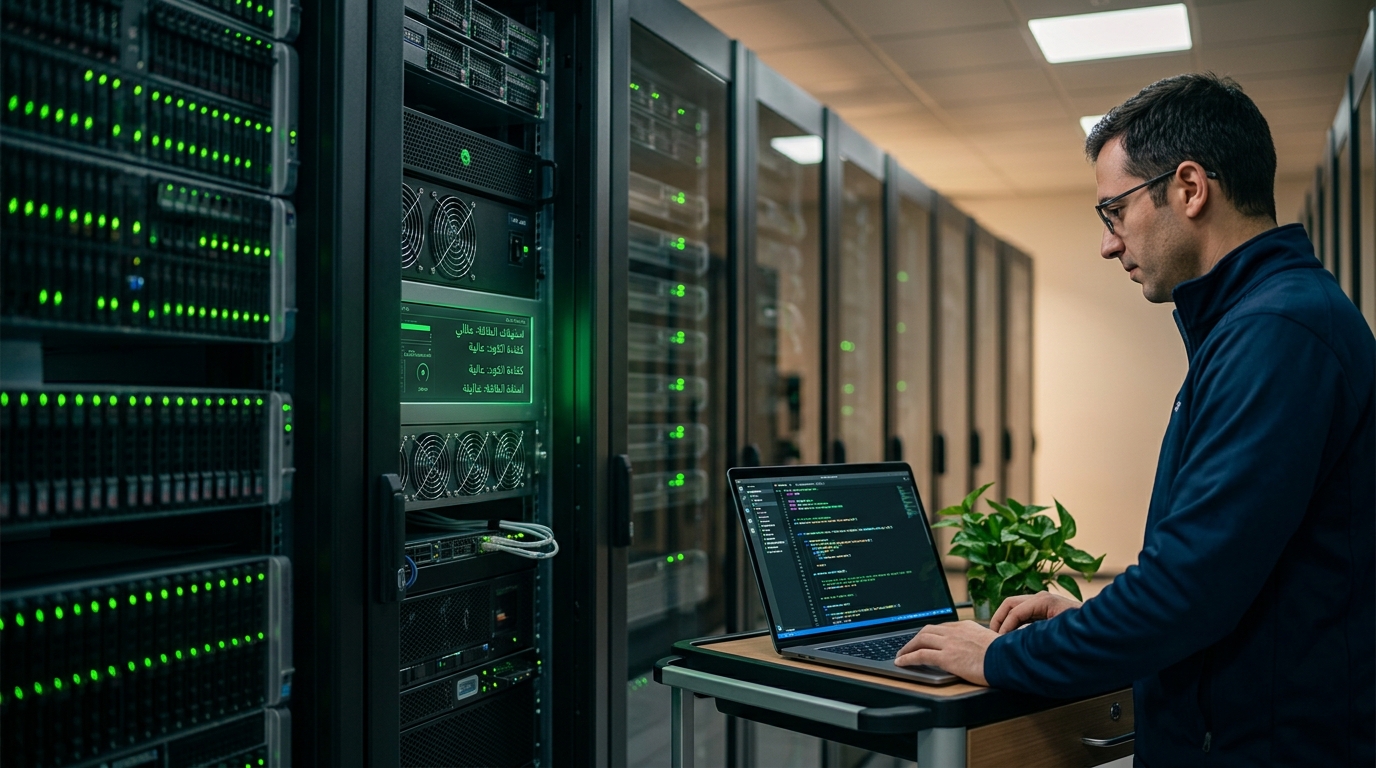
Clean Code: Fueling the Digital Future – How to Reduce Energy Consumption in Your Servers
Introduction
Amidst the accelerating digital revolution we are experiencing, the number of servers and data centers around the world is increasing at an unprecedented pace to meet the growing demand for diverse digital services, from smartphone applications and e-commerce websites to artificial intelligence platforms and big data analytics. This massive expansion, while representing a great technological achievement, poses a serious environmental and economic challenge in the form of a steady rise in electricity consumption, placing increasing pressure on the planet's resources and contributing to the worsening problem of climate change.
The primary focus of software developers has always been on code functionality, performance, and maintainability, which are essential aspects for the success of any software project. However, with the worsening energy crisis and increasing environmental awareness, a new and crucial dimension has emerged that must be considered when writing code: energy efficiency. It is no longer enough for code to work correctly or quickly; it has become essential for it to consume the least possible amount of resources, especially energy, to achieve its goals.
Here, the concept of 'Clean Code' emerges as a pivotal solution whose impact is not limited to software quality and ease of development and maintenance, but extends to become an effective strategy for rationalizing energy consumption in servers and data centers. Adopting clean code practices is not merely an aesthetic or engineering preference; it is a long-term investment in environmental and economic sustainability, contributing to building a more efficient and responsible digital future.
Background and Context
The past few decades have witnessed an unprecedented boom in reliance on digital technology, as our lives have been radically transformed to be constantly connected to the internet. From communication infrastructure to cloud services, through billions of connected devices, this entire digital ecosystem relies primarily on data centers and servers that operate around the clock. This rapid growth in demand for processing and storage has led to a doubling in the number and size of data centers, which in turn means a huge increase in their need for electrical energy to operate servers, cooling systems, and lighting.
Initially, energy consumption was not a primary factor in the software design and development process. The focus was on achieving the required functionalities, then optimizing performance to ensure fast response and a good user experience. However, with the increasing size and complexity of applications, and with the expansion of server infrastructures, the relationship between code efficiency and energy consumption began to become clear. Inefficient code, which performs excessive calculations, makes repetitive database queries, or uses inappropriate data structures, forces servers to exert more effort, meaning higher consumption of CPUs, RAM, and storage units, and thus more energy.
This direct relationship between code quality and energy consumption has prompted the technical community to rethink software practices. It is no longer enough to simply write functional code; it has become essential to write 'smart' code that consumes the least possible amount of resources to achieve its goals. This shift in programming thought is what paves the way for integrating clean code principles, which aim to simplify code and make it more readable and maintainable, with sustainability goals and reducing the carbon footprint of data centers, creating a balance between performance and environmental efficiency.
Details and Key Facts
Global estimates indicate that data centers consume between 1% to 3% of the total electricity produced worldwide, a percentage that seems small at first glance, but exceeds the total energy consumption of entire countries. With the expected growth of the digital sector, this percentage could rise significantly over the next decade if effective measures are not taken to rationalize consumption. This is not limited to the direct electricity consumption of servers, but also includes the energy required to cool these servers, as cooling systems can consume up to 40% of a data center's total energy, highlighting the importance of reducing the thermal load resulting from computational operations.
Unoptimized software is one of the main reasons behind this energy waste. For example, using inefficient algorithms can increase the number of computational operations required to solve a problem by hundreds or thousands of times compared to an optimized algorithm, meaning greater CPU consumption for longer periods. Likewise, excessive or unoptimized database queries lead to an overload on servers and databases, causing slow response and energy consumption far exceeding what is required. These poor programming practices accumulate to form a huge energy burden on the infrastructure.
Other examples of energy-wasting code include: code containing infinite or poorly controlled loops, or code that creates many unnecessary objects in memory, which increases the load on the Garbage Collector and consumes additional processing cycles. Also, excessive use of I/O operations on disk or network, or excessive logging without need, are all factors that indirectly increase energy consumption by increasing the load on hardware components. Awareness of these subtle details is the first step towards writing more efficient and environmentally friendly code.
Impact and Importance
Adopting clean code strategies to reduce energy consumption goes beyond merely improving technical performance, extending its impact to broad environmental, economic, and social dimensions. Environmentally, reducing energy consumption in data centers directly contributes to lowering the carbon footprint of the technology sector, as a large portion of the electricity used globally is still generated from fossil fuel sources. Every watt saved reduces greenhouse gas emissions, supporting global efforts to combat climate change and protect natural resources for future generations.
Economically, energy efficiency means huge savings in operating costs for companies and institutions that rely on data centers. Electricity bills represent a significant portion of data center operating expenses, and reducing this consumption directly translates into higher profit margins or the ability to invest these savings in other areas. Furthermore, clean and more efficient code reduces the need for costly equipment upgrades or continuous infrastructure expansion, as existing servers can handle a larger workload with the same or better efficiency.
The impact is not limited to the environment and economy alone, but extends to the quality of digital products and user experience. More efficient code leads to faster and more responsive applications, which improves user satisfaction and reduces the energy consumption of their devices (such as smartphones and laptops) that interact with these servers. Also, clean code by nature is easier to read, maintain, and scale, which reduces development time and lowers the rate of software errors, thereby enhancing the reliability and stability of the digital services provided. It is a comprehensive approach that benefits all stakeholders.
Opinions and Analyses
Software engineering experts and sustainability advocates agree that clean code is no longer just a preferred practice for improving software quality, but has become an urgent necessity to address current environmental and economic challenges. Many developers believe that thinking about energy efficiency should be an integral part of the design and development process from the early stages of a project, not just an optimization performed later. This requires a change in developers' mindset to integrate the concept of 'Green Software Engineering' into the core of their daily work, and to seek software solutions that are as efficient in performance as they are environmentally friendly.
In-depth analysis indicates that one of the biggest challenges in this field is the absence of standardized metrics for measuring energy consumption at the code level. While tools exist for measuring code performance (such as execution speed and memory usage), tools specifically designed to measure direct code energy consumption are still under development or not widely adopted. This makes it difficult for developers to identify the most energy-consuming parts of their applications and take corrective actions. However, developers can use traditional performance indicators as a guide, as faster and less memory-intensive code is often also less energy-consuming.
Many opinions emphasize that adopting clean code to achieve energy efficiency does not represent an additional burden on developers, but rather an investment that yields long-term benefits. Clean code that follows principles such as DRY (Don't Repeat Yourself) and SOLID, and that uses optimized data structures and algorithms, is inherently more efficient and consumes fewer resources. These practices not only reduce energy consumption but also improve code readability, maintainability, and scalability, which reduces the total cost of ownership (TCO) and makes development teams more productive. It is a win-win strategy for everyone: developers, businesses, and the planet.
Outlook and Future
The future is moving towards a deeper integration of sustainability concepts into the core of the software industry. We expect to see significant developments in 'Green Software Engineering' tools and metrics, which will enable developers to directly and effectively measure and improve the energy efficiency of their code. New programming languages and frameworks may emerge specifically designed with energy efficiency in mind, or existing languages may incorporate features that help write more sustainable code by default. 'Energy efficiency' will become a fundamental criterion for evaluating code quality, just as performance and maintainability are currently.
In terms of education and training, the importance of teaching clean code principles geared towards energy efficiency in universities and technical institutes is likely to increase. New developers will be required to acquire a deep understanding not only of how code works, but also of its impact on physical resources and energy consumption. The industry will witness a shift towards a culture of 'sustainable programming,' where thinking about the carbon footprint of applications becomes an integral part of the entire software development lifecycle, from initial design to deployment and maintenance.
Governments and regulatory bodies can also play an increasing role in this area, by setting standards or incentives for companies that adopt sustainable software practices. We may see the emergence of environmental certifications or ratings for software, encouraging companies to compete in providing more energy-efficient digital solutions. These developments will drive innovation in green computing and contribute to building a global digital infrastructure that is not only powerful and flexible, but also environmentally responsible and sustainable in the long term.
Conclusion
In conclusion, clean code is no longer just a technical term that interests an elite group of developers; it has transformed into a strategic necessity imposed by current environmental and economic challenges. The ability to write software code that not only performs its function efficiently but does so with the least possible energy consumption is the skill that will define the future of developers and companies in the digital age. Every efficiently written line of code is a step towards reducing the carbon footprint, conserving resources, and building a more sustainable digital infrastructure.
The responsibility lies with everyone involved in the software development lifecycle, from architects who lay out initial designs, to developers who write the code, to project managers who make decisions. Thinking about energy efficiency must become an essential part of every stage, and a culture of environmental awareness must be fostered within teams. Investing in training on clean code practices geared towards energy efficiency is not a luxury, but an imperative necessity for achieving continuity and leadership in a market moving towards sustainability.
Let us imagine a digital world where the power of technology is not measured solely by its complexity or maximum speed, but by its environmental responsibility and its ability to balance innovation with the preservation of the planet's resources. Clean code is the key to this promising future, and it is the fuel that will drive the digital progress towards a brighter and more sustainable horizon for all. Let us begin today to build this future, one clean line of code at a time.
Related Articles

How to Increase Your Profits Using SEO: A Comprehensive Guide to Search Engine Optimization and Revenue Growth
Why is SEO your best investment? 75% of users do not go beyond the first page of search results, and 67% of clicks go to only the first five results. Your absence from these results costs you customers and profits every day.

Nova Digital Solutions: Your Partner in Digital Success
Discover how Nova Digital Solutions transforms your vision into a tangible reality through innovative technological strategies, becoming your ideal partner in the digital transformation journey and achieving leadership in the competitive business market.

The Future of the Digital Content Industry in the Era of Smart Algorithms
The world of digital content is witnessing a radical transformation thanks to the rise of smart algorithms, which are no longer limited to recommendations but extend to include creation and distribution, completely reshaping the landscape for both content creators and audiences. Understanding this fundamental shift, its challenges, and opportunities has become an urgent necessity for everyone looking to stay ahead in the constantly evolving digital landscape.