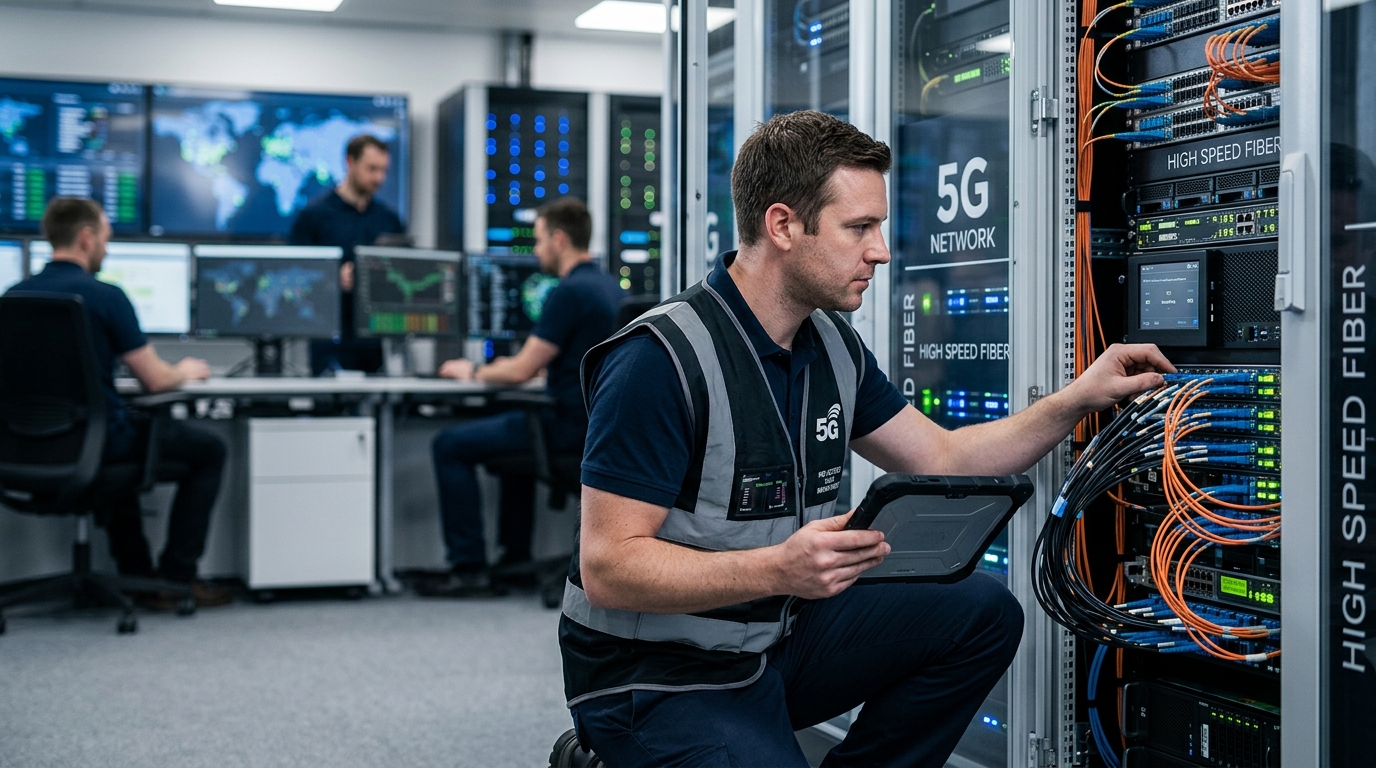
5G Networks: A Direct Impact on the Architecture of Interactive Applications
Introduction
Connectivity speed and quality have always been the primary drivers of innovation in the world of digital applications, but what 5G networks offer goes beyond mere incremental improvements to bring about a comprehensive structural revolution. It is no longer just about loading pages faster or watching videos without interruption; it is about a complete redefinition of the concept of digital interaction, opening unprecedented horizons for developers and users alike.
At the heart of this revolution lies the ability to process massive amounts of data at extremely high speeds, coupled with near-zero latency and the capacity to connect a huge number of devices simultaneously. These three characteristics combined are fundamental pillars for developing a new generation of interactive applications that require instant response and immersive environments, such as cloud gaming, augmented reality (AR), virtual reality (VR), smart industrial applications, and advanced communication systems.
This article aims to explore the direct and profound implications of 5G networks on the architecture of interactive applications, and how this technology does not merely impose simple adjustments but requires a radical redesign and rethinking of how these applications are built and operated. We will delve into the technical details, market impacts, and future analyses of this qualitative leap that will shape the features of our digital world for years to come.
Background and Context
Since the dawn of mobile communications with 1G networks, which focused on analog voice, through 2G which introduced text messages and basic data, to 3G which enabled mobile internet browsing, and 4G which brought a boom in high-definition video consumption and broadband-dependent applications, every technological leap has broken barriers and opened new doors. However, 4G networks reached their limits in meeting the demands of modern applications that require ultra-fast response times and continuous connectivity for tens of billions of devices.
5G networks come to address these limitations radically, based on three main pillars: First, enhanced Mobile Broadband (eMBB), which provides unprecedented upload and download speeds reaching several gigabits per second, enabling the transfer of massive amounts of data in moments. Second, Ultra-Reliable Low-Latency Communications (URLLC), which reduces latency to less than 1 millisecond, crucial for applications requiring immediate and precise responses such as autonomous driving and remote surgery. Third, massive Machine Type Communications (mMTC), which allows connecting millions of devices per square kilometer, opening the door for large-scale Internet of Things (IoT) and integrated smart cities.
These three pillars represent not just quantitative improvements but a qualitative change in how developers think about their application architecture. Current interactive applications are often constrained by the latency and bandwidth limitations of 4G networks, forcing developers to make compromises in graphics quality, interaction complexity, or heavy reliance on local processing on the device. With 5G, it becomes possible to offload massive computational workloads to the cloud or Edge Computing, freeing end devices from their processing power limitations and opening up vast possibilities for innovating richer and more flexible interactive experiences.
Key Details and Facts
To appreciate the true scale of change brought by 5G networks, one must look at the figures and capabilities they offer. While 4G networks provide an average download speed ranging from 20-50 Mbps, 5G networks can reach peak speeds exceeding 10 Gbps under ideal conditions, and average speeds can easily exceed 100 Mbps in most real-world scenarios. This enormous difference in speed means that downloading a full high-definition movie can take mere seconds instead of minutes, changing the game for content streaming and data-rich applications.
As for latency, the most critical factor for interactive applications, 5G dramatically reduces this time from approximately 20-30 milliseconds in 4G to less than 1 millisecond in some sensitive applications. This reduction virtually eliminates any perceptible delay between action and response, enabling experiences that were previously impossible. For example, in cloud gaming, ultra-low latency means that player commands are executed instantly on remote servers, providing a smooth gaming experience comparable to games running locally on high-end consoles. It also opens the door for instant interactions in augmented reality applications that require real-time processing of visual and spatial data.
Furthermore, 5G networks are characterized by their ability to support massive connection density, capable of connecting up to one million devices per square kilometer, compared to approximately 100,000 devices per square kilometer for 4G networks. This capability is vital for large-scale Internet of Things (IoT) applications, which include smart sensors in cities, factories, and homes. With such a huge number of connected devices, interactive applications can collect real-time data from multiple environments, analyze it, and provide immediate responses, paving the way for fully integrated smart systems, from intelligent traffic management systems to remote health monitoring systems that continuously collect vital data.
Impact and Significance
The direct implications of 5G networks on the architecture of interactive applications translate directly into a radical transformation of the user experience. With ultra-high speeds and ultra-low latency, applications will become more responsive, seamless, and realistic than ever before. It will not be limited to merely "performing a function," but will be about delivering immersive experiences that exceed current expectations. In gaming, developers will be able to deliver console-quality graphics on any 5G-enabled device by offloading processing to cloud servers. In augmented reality, digital layers will interact with the real world seamlessly, without delay that breaks immersion or limits developers' creative possibilities.
Economically, 5G networks open up entirely new horizons for the application business model. Developers are no longer constrained by the capabilities of individual devices, allowing for the creation of subscription-based services that offer high-quality experiences across any device. This could lead to the emergence of new types of interactive applications that leverage real-time data via IoT, or advanced AR services that can be integrated into sectors such as retail, education, and vocational training. Startups and independent developers will find unprecedented opportunities to deliver innovative solutions that previously required massive investments in infrastructure or expensive specialized hardware.
The importance of 5G extends beyond entertainment applications to include other vital sectors, bringing about a profound transformation in how they operate. In healthcare, 5G can enable highly precise remote surgery, real-time patient monitoring using advanced sensors, and immersive interactive medical consultations. In manufacturing, engineers will be able to create "digital twins" of factories and machines, allowing for predictive monitoring, remote maintenance, and precise automated control, increasing efficiency and reducing breakdowns. In education, virtual classrooms and augmented reality will offer unparalleled interactive and personalized learning experiences, breaking down barriers of time and space in access to knowledge.
Opinions and Analyses
Experts and developers view 5G networks not merely as an "evolution" but as a "revolution" in application architecture. From a developer's perspective, this technology requires a radical rethinking of application design philosophy. Instead of focusing on optimizing application performance within device limits, the focus shifts to how to efficiently distribute workloads between the device, Edge Computing, and the central cloud. This means a need for new skills in distributed systems engineering, real-time data management, and securing complex infrastructures that span multiple network domains.
Analytically, many thought leaders in the industry point out that 5G will enable the "democratization" of advanced technologies. Applications that previously required powerful and expensive hardware, such as professional AR glasses or high-end gaming units, can now run on simpler, less expensive devices, as long as they are connected to a 5G network. This shift will make these technologies accessible to a wider segment of users, accelerating the pace of innovation and adoption. Some also believe that this will lead to the erosion of the concept of an "application" as a separate entity, transforming it into a contextual, flowing experience that seamlessly integrates with the user's surrounding environment.
However, this revolution is not without its challenges and concerns. The deployment of 5G infrastructure remains costly and complex, facing regulatory and logistical hurdles in many regions. There are also growing concerns about cybersecurity, as the massive number of connected IoT devices significantly expands the potential attack surface, requiring more stringent and complex security strategies. Additionally, the collection and analysis of vast amounts of real-time data raise issues related to privacy and ethics, requiring clear regulatory frameworks to protect user data and ensure the responsible use of these advanced technologies.
Expectations and Future
As 5G networks continue to spread, we are heading towards a future where interactive applications transcend the boundaries of our familiar screens. We anticipate the emergence of entirely new categories of applications that were previously impossible, such as Holographic Communication, which will allow us to interact with others as if they were present with us in the same room, regardless of the actual distance. Augmented reality applications will also become prevalent, where digital layers will interact with the physical world not only visually but also audibly and tactilely, creating rich and continuous Mixed Reality experiences.
Existing applications will evolve significantly to leverage 5G's new capabilities. For example, social media platforms will become more immersive, with the ability to share 3D experiences in real-time and interact with content in unprecedented ways. In e-commerce, users can virtually try products with high accuracy and realism before purchasing, or even interact with AI-powered virtual sales agents in immersive shopping environments. Personal services will go beyond mere recommendations, becoming predictive and interactive, based on continuous analysis of environmental data and user behavior.
The future of interactive applications does not depend solely on 5G itself, but on its synergy with other technologies such as Edge Computing and Artificial Intelligence (AI). Edge Computing will enable data processing closer to its source, minimizing latency and reducing pressure on the central network. AI, meanwhile, will provide the ability to analyze this massive data quickly and efficiently, allowing applications to intelligently interact with users and their environments, and deliver personalized and dynamic experiences. This combination will lead to the emergence of truly smart cities, autonomous transportation systems, and integrated work environments where devices and applications interact seamlessly to enhance productivity and user comfort.
Conclusion
In conclusion, the transformative impact of 5G networks on the architecture of interactive applications cannot be overstated. It is not merely a speed upgrade, but a qualitative leap that redefines what is possible in the digital world. From lag-free cloud gaming to ultra-precise remote surgery, from immersive augmented reality to interconnected smart cities, 5G opens the door to an entirely new level of interaction, where technology becomes transparent and seamlessly integrates with our daily experiences.
This transformation requires developers and businesses to rethink their strategies and adopt new design models that leverage 5G's unique capabilities in speed, low latency, and massive connectivity. The focus must be on building flexible, distributed applications that can utilize edge and cloud computing to deliver rich experiences on any device, anywhere. It is a call for bold innovation and out-of-the-box thinking, as the old boundaries of connectivity no longer exist.
As we move forward into this new era, all stakeholders – developers, telecommunications companies, policymakers, and users – bear the responsibility of understanding and embracing these changes. The future of interactive applications, powered by 5G, promises a more connected, intelligent, and experience-rich future. We must be prepared to embrace this future and build a digital world that reflects the limitless potential of this revolutionary technology.
Related Articles

How to Increase Your Profits Using SEO: A Comprehensive Guide to Search Engine Optimization and Revenue Growth
Why is SEO your best investment? 75% of users do not go beyond the first page of search results, and 67% of clicks go to only the first five results. Your absence from these results costs you customers and profits every day.

Nova Digital Solutions: Your Partner in Digital Success
Discover how Nova Digital Solutions transforms your vision into a tangible reality through innovative technological strategies, becoming your ideal partner in the digital transformation journey and achieving leadership in the competitive business market.

The Future of the Digital Content Industry in the Era of Smart Algorithms
The world of digital content is witnessing a radical transformation thanks to the rise of smart algorithms, which are no longer limited to recommendations but extend to include creation and distribution, completely reshaping the landscape for both content creators and audiences. Understanding this fundamental shift, its challenges, and opportunities has become an urgent necessity for everyone looking to stay ahead in the constantly evolving digital landscape.